City Center
Mr. MercedesCity Center is an auditorium and event complex whose surrounding parking lot becomes the site of the City Center job-fair massacre. The location first gathers people seeking work amid economic hardship; when a stolen car is driven into the packed queue, the job fair’s promise of opportunity is overturned by mass violence. Its significance continues long after the attack: the victims and survivors shape the investigation, the killer’s manipulation of a survivor, and K. William Hodges’s sense of responsibility for preventing another atrocity.
Setting and the Job Fair
The auditorium stands beyond a wide, steep drive, with a large parking lot reached from Marlborough Street. From a rise near Harper Road and Hanover Street, City Center and the Midwest Culture and Arts Complex dominate the distant downtown skyline. The auditorium’s architecture is described as conspicuously seventies in style; on the night of the fair, that building and its broad approach become a landmark for people arriving long before the doors open.
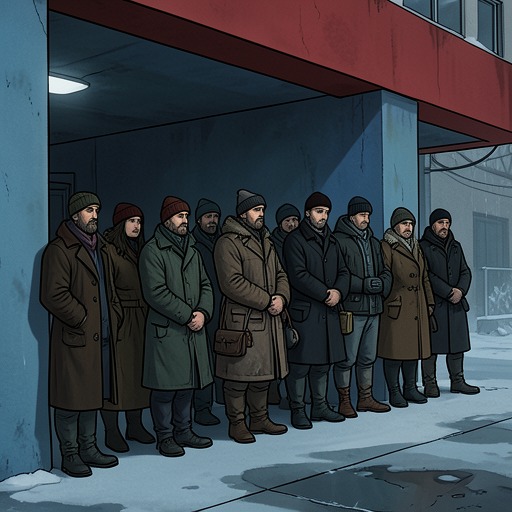
The First Annual City Job Fair promises “1000 JOBS GUARENTEED!” Yet the people assembling outside have little reason to expect easy prosperity. Cars climb the hill through the night, and their passengers join the queue in groups, while the lot that will fill by daylight remains mostly empty. The job seekers have come from financial strain and unemployment; the line’s size grows until it is estimated at about four hundred people, with the prospect of many more by opening time.
The venue’s queue is shaped by yellow DO NOT CROSS tape strung between posts. The barriers form a maze of switchbacks, compressing the waiting applicants into a narrow space and keeping them organized as they approach the doors. The system serves the practical purpose of holding a large crowd, but its tightly packed design leaves those nearest the entrance with little room to escape when the car arrives.
The Attack on the Grounds
Before dawn, fog obscures the queue and the parking area. As the light rises, the auditorium gradually comes into view, along with two dozen switchbacks and a line that continues into the fog. The doors remain closed, and a janitor passing inside prompts a small, sardonic cheer from the waiting crowd. These details mark the transition from a long, uncomfortable night of waiting to the brief expectation that the fair will soon begin.
That expectation ends when a Mercedes accelerates toward the most tightly packed part of the crowd. The tape and posts impede those near the doors: people collide with the barriers, become caught in the tape, and are pushed against one another as the queue buckles. Some at the back manage to get away, but those closest to the entrance have far less chance to move clear. Older and smaller people are knocked down and trampled in the disorder. The location’s crowd-control arrangement, designed to organize access to the fair, becomes part of the danger because it constrains movement at the point of impact.
Augie Odenkirk, who had expected to be first in line after arriving by the last bus, is among those caught in the crush. He is knocked down beside a sleeping bag and struggles to get upright amid the moving crowd. The sequence locates the violence not in the auditorium itself but along its entrance approach, among applicants who had waited through the night in hope of finding work.
Aftermath and the Location’s Continuing Presence
The attack gives City Center a lasting meaning beyond its function as an event venue. In a letter to Olivia Trelawney, the perpetrator identifies himself as the man who stole her Mercedes and drove it into the crowd. K. William Hodges later compares the different letters sent to himself and Olivia: one adopts a taunting, arrogant voice, while the other presents an apparent confession marked by remorse and childhood-abuse claims. The venue’s massacre is thus not only a crime scene but also the occasion the killer uses to manipulate its survivor and to draw Hodges into renewed investigation.
Hodges’s reflections on homicide place the attack within the work of pursuing evidence and waiting for hidden facts to emerge. He thinks of Olivia’s death and asks whether she might actually have heard ghosts, linking the case’s unresolved questions to the aftermath of City Center. The location’s violence remains present in the investigation even when characters are elsewhere, because its consequences continue to shape what they believe about guilt, truth, and responsibility.
The massacre also changes how Hodges imagines the danger of another crowded event. Pete Huntley recalls refusing to let his daughter take part in a competition at City Center: he pictured another stolen vehicle driving into children and parents waiting outside in the fog. His fear proves unfounded in that instance, but the scene demonstrates how the original attack has altered ordinary decisions about public gatherings. City Center becomes a place associated not only with the people harmed there, but with the possibility of a similar attack wherever a crowd is gathered.
Investigation, Threat, and Significance
Years later, the location remains central to the stakes of the investigation. When K. William Hodges warns Holly Gibney that Brady Hartsfield may have more explosives and could use them on a crowd, he invokes the way Hartsfield used Olivia’s Mercedes against the City Center crowd. The precedent makes the threat concrete: the earlier attack is the model for the larger danger Hodges fears, and it helps explain why he believes he cannot simply abandon the pursuit.
When Hodges concludes that he must contact the police, he recognizes that Hartsfield is at large and that he can no longer justify withholding the perpetrator’s identity and description. He sees the possibility that the killer may evade capture and commit another atrocity, while his immediate concern is also to protect Jerome Robinson and Holly. City Center therefore remains an active measure of consequence in the present: the original massacre gives urgency to decisions made far from the auditorium, and the possibility of repetition makes the location’s history a continuing warning.
The novel’s treatment of City Center turns a public promise into a bitter structural irony. The fair’s guaranteed jobs attract people who need security; the taped queue makes their arrival orderly, but also confines many of them when danger comes. The building’s banner and closed doors frame a crowd waiting for access, while the attack makes the place synonymous with what that promise could not protect. City Center is at once a specific venue, the setting of a mass crime, and the recurring reference point through which survivors, investigators, and those close to them measure the risk of another crowd becoming a target.